
Case study
Case study
A digital home for MAST's record of polar shipwrecks
The Maritime Archaeological Sea Trust safeguards the world's underwater heritage. As the climate shifts and Arctic sea ice retreats, vessels that have rested beneath polar waters for centuries are re-entering view, both as a research opportunity and as a preservation risk.
The Arctic Loss List is MAST's authoritative record of these wrecks. It needed a home that matched the weight of the work.
About the Project
Assessing the Risks from Potentially Polluting Wrecks in Arctic Waters
Between August 1941 and May 1945 seventy eight convoys sailed from the United Kingdom, Iceland and North America to the Soviet Union as part of the vast Allied effort to supply the USSR during the Second World War. In total over 1400 merchant ships delivered almost four million tons of goods via this Arctic route. However, casualties were high, with at least 104 merchant vessels lost to enemy action and extreme weather alongside 16 allied warships. In turn 34 German warships and submarines were sunk while hunting the convoys, as well as large numbers of aircraft.
Eighty years later the environmental risk posed by the remains of these vessels that contain large quantities of oil, chemicals, ammunition and other hazardous materials are now the cause of international concern. As these wrecks degrade, they will inevitably release their cargoes and fuel stores into the environment with an uncertain impact on the marine ecosystem. The risks are compounded by the fact many of the wrecks are scattered across a vast and remote area of ocean, within the environmentally sensitive Arctic Circle where pollution could cause serious harm, and where spills may not be rapidly identified. These sites are hard to monitor using traditional maritime patrols, but new technology may provide a solution.
This project was funded by the Lloyd’s Register Foundation and carried out by the Maritime Archaeology Sea Trust (MAST) to address this issue. Researchers trawled the archives to identify the locations of all military and merchant vessels lost in the area of the Arctic convoys during both the First and Second World Wars. Each vessel was assessed for pollution risk and compiled into a GIS database. Using the data collected MAST analysts used a range of satellite-based remote sensing techniques to examine all the wreck sites identified for evidence of pollution. This approach has already been successfully applied in other regions to identify oil seeping from decaying wrecks, and to spot catastrophic releases triggered by human interference such as salvage, fishing or military activity. The data was also assessed for leaks which cannot be correlated with known wreck sites or subsea infrastructure, and which may indicate the location of previously unknown or missing wrecks. As Arctic waters once again face geopolitical tensions in the Twenty-First Century, it is hoped this technology will provide a means to manage the toxic legacy of Twentieth-Century conflicts.
The brief
A fine starting point. But it made three things hard.
The public, journalists, and partner institutions had no easy way to browse or search the archive.
Adding, editing, and correcting entries needed a structured workflow, not ad-hoc file edits.
Sensitive curatorial work cannot sit next to public content; access has to be deliberate.
Our approach
Audience one
For general visitors, partners, and press. Browsing the archive should feel like leafing through a curated collection.
Audience two
For the small, trusted group who maintain the archive. Every screen is shaped around their workflow.
Behind both, a single source of truth. A change made by a curator appears, accurately and immediately, in the public view.
What we delivered
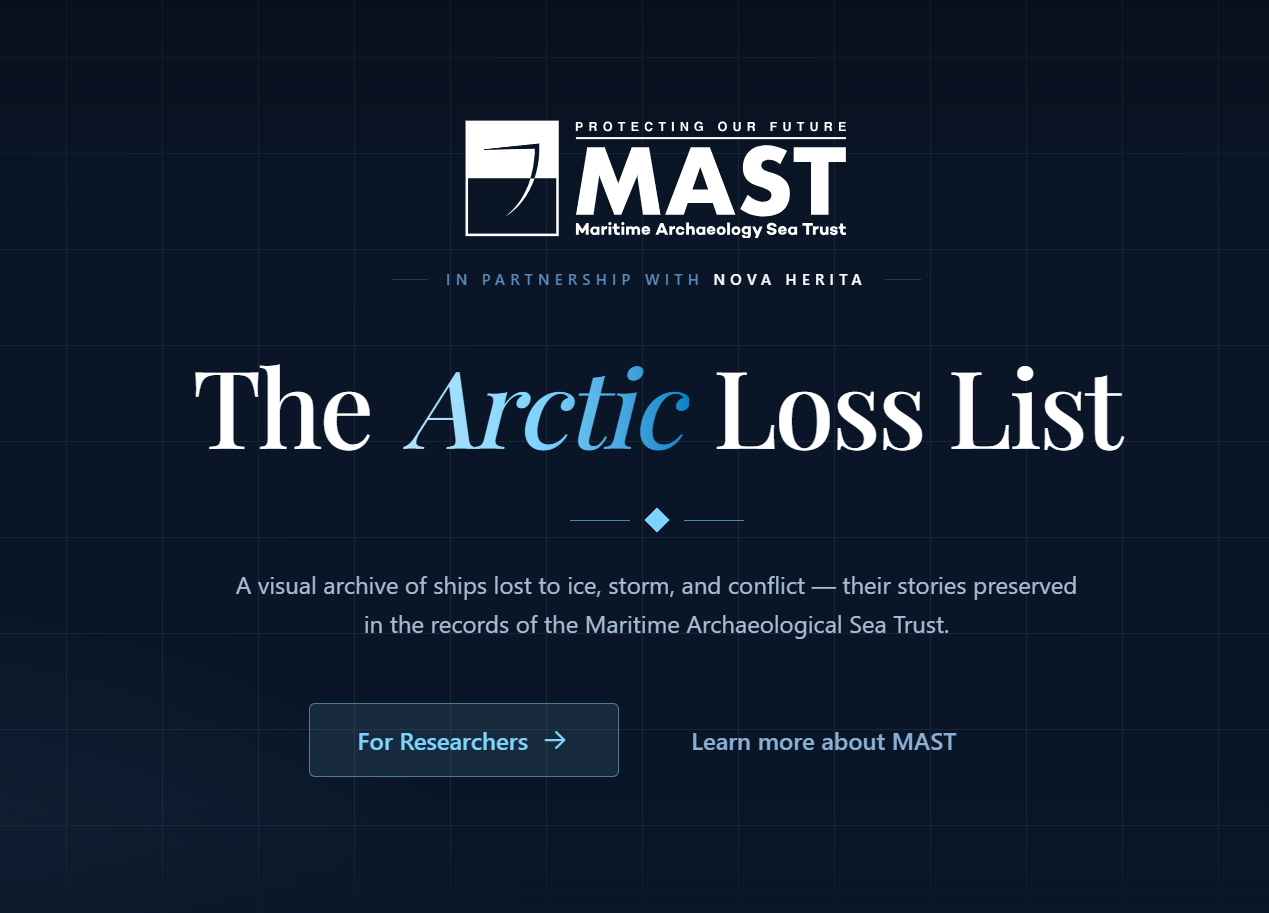
A visual entry point to the Arctic Loss List, designed for browsing rather than database-style hunting. Vessel records are presented as a curated collection: readable on a phone in the field, dignified on a desktop in a museum boardroom.
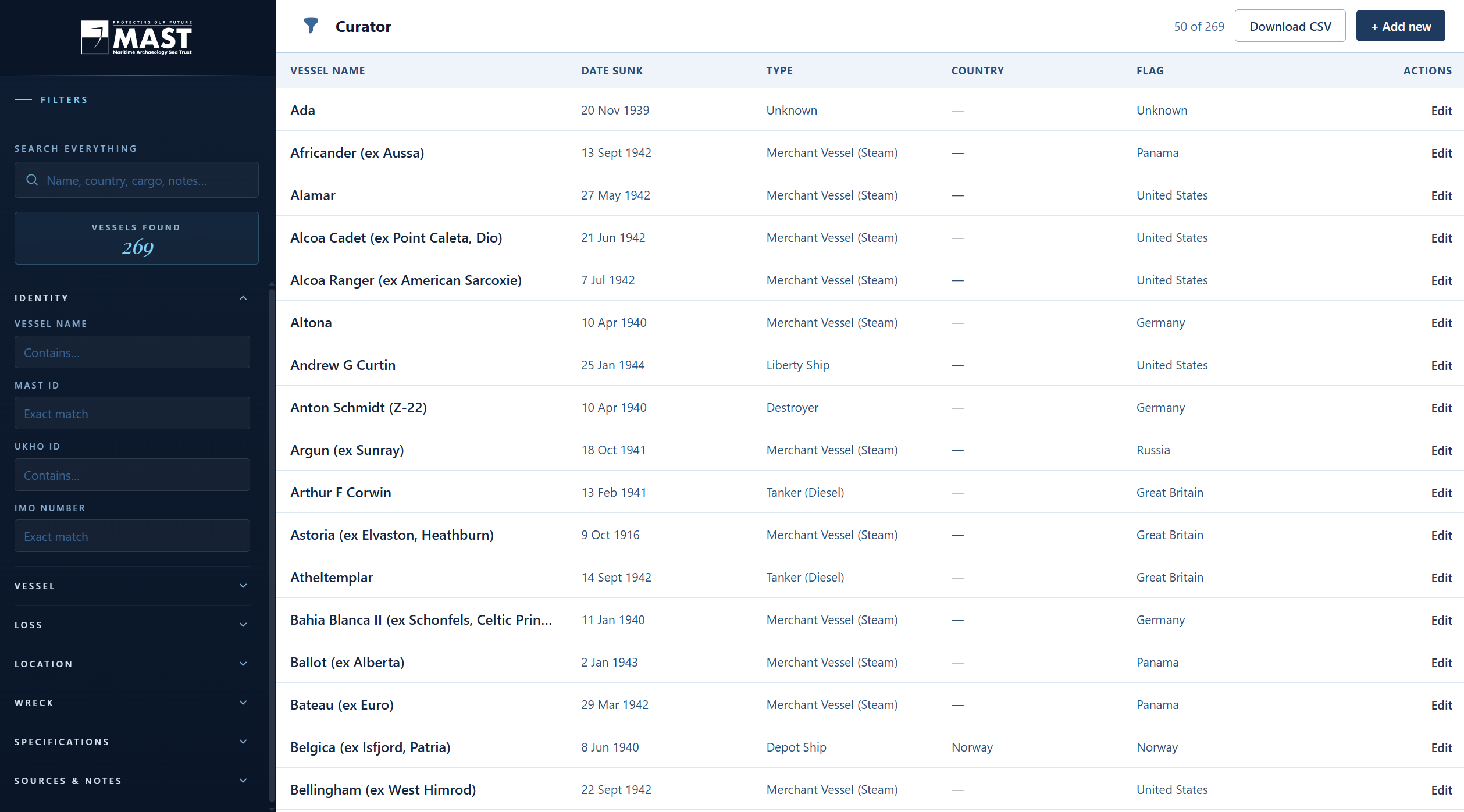
A purpose-built environment for the MAST team. Records are added, edited, and refined through structured forms shaped around the curator's workflow. Long lists are paginated for clarity, with controls that stay within reach while scrolling deep records.
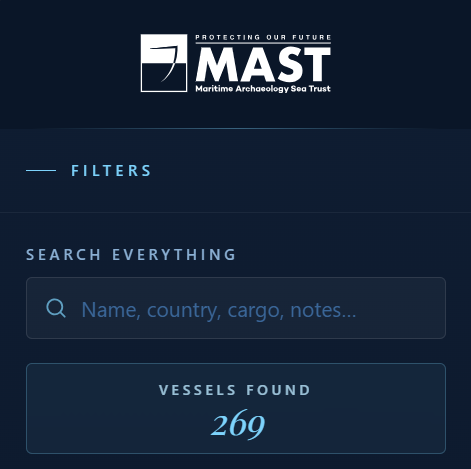
A search experience tailored to how researchers actually look for vessels. Available to authenticated users, so MAST retains control over how the archive is queried, and by whom.
Accounts are invitation-only. The platform does not accept self-registration; MAST decides who gets in. Authenticated users receive a secure password-recovery flow built around best-practice patterns.

We replaced default branding with a bespoke MAST mark and tuned the visual system across both experiences so the platform feels unmistakably MAST, not a templated product wearing a logo.
The outcome
The Arctic Loss List has its first dedicated digital home: public-facing, search-ready, and curator-managed.
MAST's curators work in an environment shaped around their process, not against it.
Visitors, partners, and press can discover the archive on their own terms.
The platform is built to grow: the Arctic Loss List is the first chapter, with the wider MAST Global Shipwreck Database following.
Future opportunities
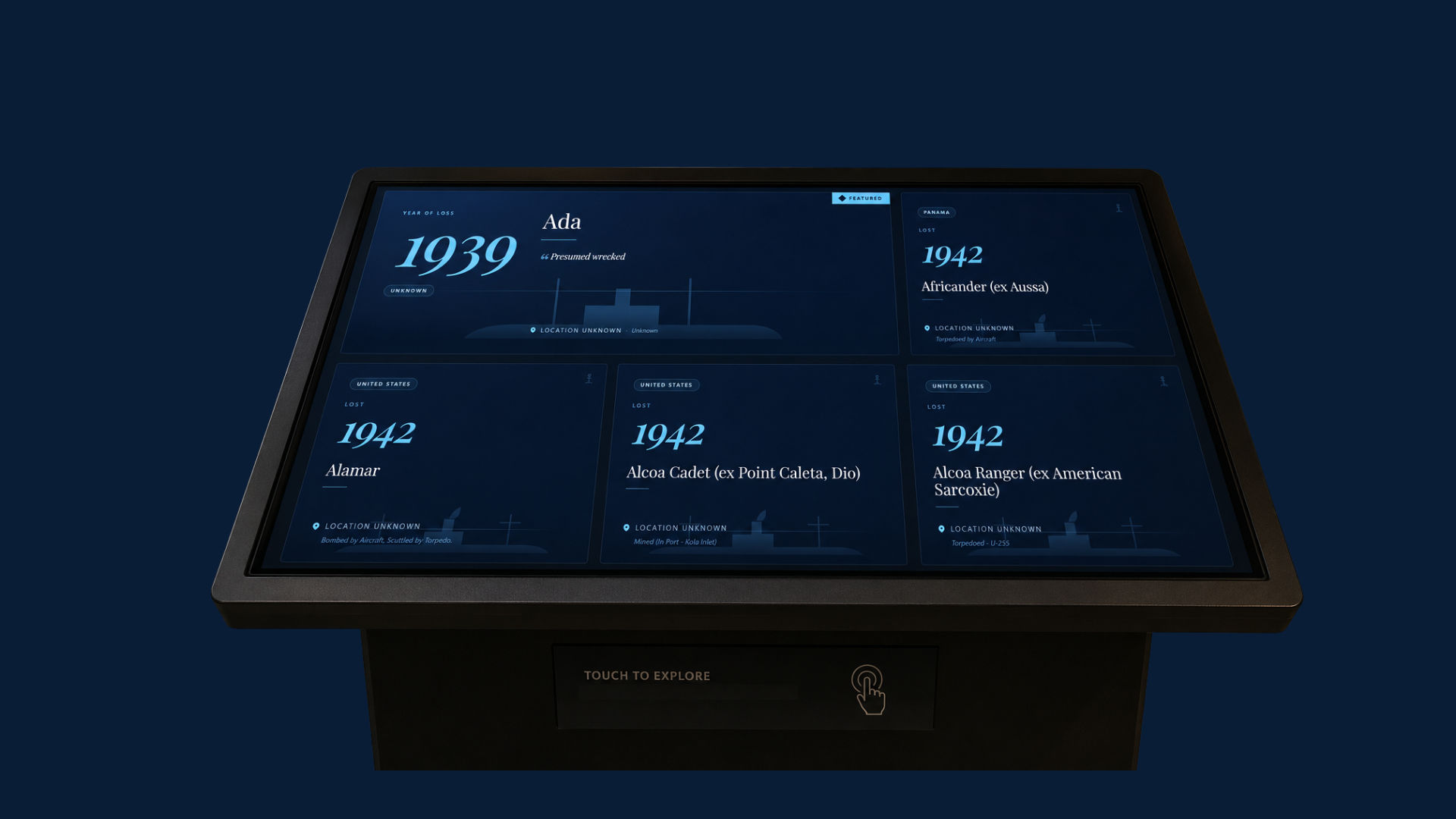
It wasn't in the brief, but an archive like this has an obvious next home: the museum floor. So we designed for that future from the start. Tap targets sized for touch, typography legible at arm's length, navigation that works without a keyboard. The day MAST puts a kiosk on the gallery floor, the software is already there.
Why it matters
Maritime heritage is a finite, rapidly changing resource. A digital archive isn't an academic exercise. It is a record.
Every year, the conditions that have preserved these wrecks for centuries become less reliable. Nova Herita is proud to have helped MAST make that record visible.